You can stay informed by subscribing to our email updates, which include our waste harmonisation newsletter.
Page contents
- What we want to achieve
- Community engagement
- Waste and recycling trials
- How the options and proposals are assessed
- Waste options consultation May to July 2025
- Current arrangements in each area
- Wheelie bin sizes
- What the options would mean for collections in each area
- Why we've chosen the options
- What happens next
What we want to achieve
Our aim is to reduce waste, increase recycling, and provide an improved service for our residents.
To achieve this, we have said that we want to create a single waste and recycling service for the whole of Westmorland and Furness.
The proposals now agreed for future waste and recycling collections in Westmorland and Furness have been independently assessed against the following six key criteria:
- Consistent Service – ensuring everyone receives the same services across all areas
- Improved Performance – making it easier and simpler for residents to waste less and recycle more
- Public perception – aligns with resident feedback from a ‘Community Conversation’ engagement, trial schemes and Options Consultation
- Carbon Impact – reduces the carbon impact of the service and contribute to the council’s net zero ambitions
- Strategic Fit - complies with Government legislation and our Council Plan ambitions
- Achievability - difficulty implementing, considering things like costs/savings, available resources, need to buy new vehicles, containers etc. and how long will it take
We want to deliver collection services that make it easier and more convenient for people to recycle more and waste less, and that are more reliable, cost-effective and better for the environment.
What has been agreed
At a meeting of Cabinet (9 September), councillors agreed new harmonised waste and recycling service arrangements for the whole of Westmorland and Furness. The following was approved:
- Collections - The roll-out of an in-house waste and recycling collection service. This means that in the future, all collections will be delivered by council teams
- General Waste - Fortnightly residual (general) waste collections, using a 240-litre wheelie bin. Collections would be the alternate fortnight to recycling collections
- Recycling - Fortnightly recycling collection service using 2 x 180-litre wheeled bins. One wheelie bin will be for plastic, cans and glass and one will be for card and paper. Collections would be the alternate fortnight to residual waste collections
- Bespoke service arrangements - Will be looked at for any residents/communities that cannot adopt wheelie bins
- Green Waste - A new subscription-based garden waste collection service is to be introduced across Westmorland and Furness from 1 April 2026.
The first changes to collection services are expected to begin rolling out in the next few months, but the full implementation will take some time to complete.
Community engagement and consultation
In November and December 2024 we started initial engagement with our‘Community Conversation’ on waste and recycling.
Nearly 3,000 people responded to the Community Conversation and gave feedback through a survey and at in-person and online events.
We used these conversations to gather your thoughts on the current waste and recycling collection services in your area – what you like, what you would like to change and what you’d like to see in the future.
Community Conversation summary results and analysis (PDF , 219KB).
The feedback from this Community Conversation was used to help shape options for future collections.
From May to July 2025, we ran an eight-week consultation and produced a survey to ask further questions to help us make a decision on the new collection services.
The survey included questions about the sizes of containers, frequency of collections and potential subscription charges for green waste collections.
We received more than 4,300 responses to the survey. Thank you to anyone who completed the survey and shared their thoughts about the proposed options.
The Options Consultation summary results and analysis is included in the Cabinet report
Alongside this, we also ran pilot trials of different collection methods and containers, giving residents in the trial areas the opportunity to try out changes and share their experiences.
This included a trial of ‘co-mingled’ recycling in Ulverston and a trial of wheelie bins in parts of the Eden area that currently have bags for general waste collections
Pilot trials summary results and analysis is also included in the Cabinet report
We have also started to roll-out the kerbside collection of beverage cartons (such as Tetrapak), starting in the Eden area, after feedback that you wanted to be able to recycle these types of items more easily.
How the options and proposals were assessed
The Council inherited a complex mix of collection methods, frequencies and types of containers used in the former district areas of Barrow, Eden and South Lakeland.
Some of our current services are delivered by Westmorland and Furness Council, and others are delivered by contractors.
As well the engagement and consultation, an independent technical review of the current and proposed waste and recycling collection services options was undertaken.
The financial implications of the different options was considered, to understand if they would be more or less cost effective than the current service.
Cost was not the only factor considered, we also assessed the various options against factors like:
- How they fit with national legislation?
- Do they make services fairer?
- How they would impact the environment?
- Whether they are sustainable?
- Whether they are achievable?
Current arrangements in each area
| Collection | Barrow | Eden | South Lakeland |
|---|---|---|---|
| General waste | 120 litre wheelie bin Weekly collection | Blue bags Weekly collection | 240 litre wheelie bin Fortnightly collection |
| Recycling | Box for glass 240 litre wheelie bin for cans, plastics, paper and card Fortnightly collection | Box for glass and cans Bag for plastic Bag for paper and card Fortnightly collection | Box for card and paper Box for glass Bag for plastic and cans Fortnightly collection |
| Green Waste | 240 litre wheelie bin Fortnightly collection (50 weeks per year) Optional service subject to separate charge | 240 litre wheelie bin or, in some cases without a kerbside collection, communal garden skips Fortnightly collection (February to November) Monthly collection (December to January) No separate charge | 240 litre wheelie bin Fortnightly collection (February to November) No separate charge |
What the changes mean for general waste and recycling in each area
General waste
| Agreed Option | Barrow | Eden | South Lakeland |
|---|---|---|---|
| Fortnightly Collection | Replace 120 litre wheelie bin with 240 litre wheelie bin Collections become fortnightly | Replace current blue bags with 240 litre wheelie bin Collections become fortnightly | Retain current 240 litre wheelie bin Collections stay fortnightly |
Recycling
| Agreed Option | Barrow | Eden | South Lakeland |
|---|---|---|---|
| Fortnightly Collection | Replace current box and 240litre wheelie bin with two new 180 litre wheelie bins, one for plastic, cans and glass and one for card and paper. Collections stay fortnightly | Replace existing boxes and bags with two new 180 litre wheelie bins, one for plastic, cans and glass and one for card and paper. Collections stay fortnightly | Replace existing boxes and bags with two new 180 litre wheelie bins, one for plastic, cans and glass and one for card and paper. Collections stay fortnightly |
Wheelie bins and sizes
The options use different wheelie bin sizes. Below is an illustration of the sizes and dimensions of the wheelie bins.
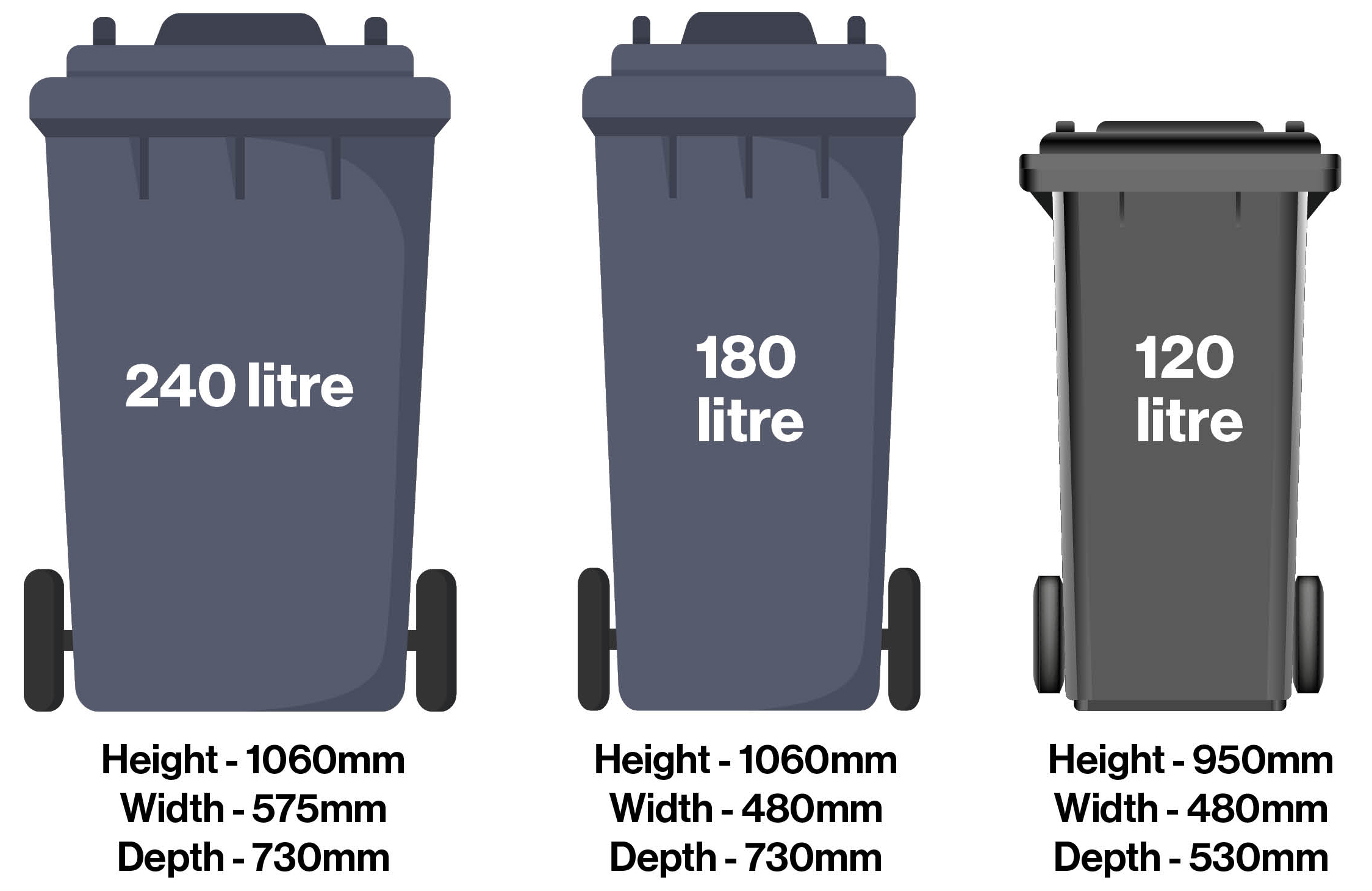
Wheelie bin measurements
- 240 litres: height 1060mm, width 575mm, depth 730mm
- 180 litres: height 1060mm, width 480mm, depth 730mm
- 120 litres: height 950mm, width 480mm, depth 530mm
Why we've chosen the options we have
Why we've agreed fortnightly general waste collections, instead of giving everyone a weekly collection.
We've tried to weigh up various factors, including resident feedback from the consultation and the six key criteria. This includes cost effectiveness, environmental impact and achievability.
While we recognise a weekly general waste collection may have been greeted positively and be perceived as an ‘improved’ service by some - and why we included it in our options for comparison - a weekly general waste collection for the whole of Westmorland and Furness would result in significant additional costs and a negative carbon impact due to the additional journeys that would need to be made by collection vehicles.
Evidence from national studies also suggests weekly general waste collections discourages recycling, with more people likely to put recyclable materials in their general waste bin if it is emptied every week.
The studies show less frequent general waste collections can act as an incentive for people to use their recycling containers more effectively.
For these reasons, the vast majority of local authorities now adopt a fortnightly general waste collection or greater (some authorities have recently moved to three-weekly or even monthly general waste collections to encourage better use of recycling facilities).
A weekly collection of general waste would also be costly to implement, requiring significant extra investment to extend weekly general waste collections to the whole of Westmorland and Furness, potentially requiring extra vehicles, and associated fuel, maintenance and staffing costs, as well as the cost of purchasing and delivering new general waste wheelie bins to all properties.
For context, there are currently 55,000 grey/black 240litre wheelie bins for general waste in service across the South Lakeland locality. Under the agreed fortnightly collection option, these 240litre bins will continue to be used and would not need to be replaced, therefore saving significant implementation costs.
Why the option agreed moves away from using bags and boxes to wheelie bins for both waste and recycling
Feedback from the Community Conversation, pilot trials in areas that currently have bags for general waste, and through the options consultation has shown that wheelie bins are considered easier and more convenient for people to use than bags for general waste.
For recycling, pilot trials have shown wheelie bins are generally easier to move to collection points, do not take up any more room than bags and boxes and make it simpler to recycle more effectively.
Feedback included that people welcomed the fact wheelie bins do not have separate lids that can get lost or blown away and they are generally more robust than separate bags and boxes so are less likely to blow over in windy conditions.
They are also quicker and easier to empty for our crews, which improves the efficiency of rounds and saves money and leads to a more reliable service.
Why the option agreed has different types of recycling mixed together in wheelie bins, instead of asking people to separate different types of recycling
In the past most councils asked residents to separate recyclable materials by type, so you may have had different containers for paper and card, plastic, cans and glass.
This used to ensure the most efficient sorting and packaging at the recycling facility and was considered the most effective way to guarantee everything collected was sent for recycling and avoided contamination.
As technology has improved at the recycling facilities, it is now possible to ‘co-mingle’ more recyclables in the same container and the latest machinery can efficiently identify and sort mixed loads into different types and grades of material.
That means, even if certain materials are ‘co-mingled’, everything we collect at the kerbside is sorted and sent for recycling. Unless it is contaminated with non-recyclable materials, no recycling we collect at the kerbside is sent to landfill.
This new technology means we can consider collecting more recyclable materials together in the same container, which would save some of the current sorting between different bags and boxes at home.
Evidence shows that making it easier for people to recycle by reducing the amount of separation needed at the kerbside encourages people to recycle more and waste less, which is one of the main aims of the changes.
Co-mingled recycling also means we don’t need special recycling vehicles, with separate compartments for each type of recycling material, and we can use the same types of bin wagons for collecting your recycling, general waste and green waste.
This makes the fleet more efficient and makes it easier to cover for any unexpected vehicle breakdown.
Emptying wheelie bins into these wagons, which have built-in lifting gear, is also quicker and easier for our crews so they can complete rounds more efficiently.
All this helps to improve the reliability of the service, reduces missed collections and increases recycling performance.
Why you will see more of your recycling being collected in 'bin' wagons
Under the new arrangements, residents will continue to separate their recycling at home, using two 180 litre wheelie bins, one for paper and card, and another for plastics, cans/tins and glass.
For most households, this will mean a change to the type of container provided, with wheelie bins replacing bags and boxes in certain areas.
Once we have picked up your recycling from the kerbside under the new arrangements, you will see the different recyclables placed together in the same collection vehicle.
Although it looks as though it is all being thrown in together, the wagons actually have two separate containers inside, so the contents of your two wheelie bins will be kept separate.
Once collected, all recycling is sent to a specialist Materials Recovery Facility (MRF), where the different materials are carefully sorted using the latest technology before being sent for reprocessing. This ensures that valuable natural resources are recovered and reused, protecting the environment and cutting waste.
As part of the roll-out, residents will begin to see more, newer and more efficient collection vehicles on their streets, as older models are phased out.
These modern vehicles will improve reliability, reduce emissions and provide the Council with greater operational flexibility to manage collections across the area effectively.
This means you will increasingly see your recycling being collected in these wagons as the old dedicated recycling vehicles are phased out.
But don't worry, everything we collect at the kerbside is sorted and sent for recycling. Unless it is contaminated with non-recyclable materials, no recycling we collect at the kerbside is sent to landfill.
Why the agreed option uses two wheelie bins for recycling, instead of one
Best practice guidance is that we should still collect card and paper separately so they don't get contaminated, but other recyclables can be 'co-mingled' in one bin.
Even though they go in one of the two wheelie bins, all these co-mingled recyclables are sorted at the plant and are sent for recycling. No recyclables that we collect at the kerbside are sent to landfill.
Our bin wagons have separate compartments inside, so even though it is being emptied into the same vehicle the recycling from the two wheelie bins wouldn’t be completely mixed together and paper and card can still be kept separate from plastic, glass and cans to avoid contamination.
Why we've chosen these wheelie bin sizes
For general waste, a 240litre capacity general waste wheelie bin will comfortably take around five or six standard bin bags used in a 30 litre kitchen bin, which evidence has shown is more than adequate capacity for a typical family’s needs over two weeks if recyclables are removed.
Two 180 litre recycling wheelie bins collected fortnightly means increased recycling capacity in most areas that currently have separate bags and boxes for recycling, with more capacity especially for cardboard and plastic, which are the largest volumes of kerbside recycling collected.
Increased recycling capacity and the convenience of wheelie bins makes it easier and more convenient for people to recycle, meeting one of our key objectives.
Arrangements for properties that do not have room for two recycling wheelie bins
The recycling wheelie bins under the option agreed are 180 litre size.
This means they are smaller and narrower than a 240litre general waste bin.
Two 180 litre wheelie bins for recycling take up approximately the same floorspace as two recycling boxes and a recycling bag.
However, we do recognise that in some specific cases there may not be sufficient room for every property to have all the containers, such as flats and apartments and some types of terraced or cottage-style properties without yards or outside space.
The Cabinet decision made clear that the council, as we already do in such circumstances, will continue to look at these specific cases individually and will work with the householder to come up with a suitable solution where appropriate.
As part of the roll-out this could include local drop-ins and whole community solutions if there are many properties in an area that cannot adopt wheelie bins.
We will also continue to offer assisted collections to anyone who is unable to move their containers to the collection point.
The collection approach and size and type of container to be used was agreed following feedback received from thousands of our residents through engagement, consultation and pilot trials over the past year and the agreed collections system reflects the wishes of a majority of those people.
However, we also recognise it won’t be perfect for everyone, which is why these provisions are being made as part of the implementation roll-out.
Whether we'll need to provide everyone with a new set of wheelie bins
It depends where you currently live.
For example, now it has been decided that a 240 litre bin will be used for for general waste, 55,000 residents in South Lakeland who currently already have a 240 litre grey/black wheelie bin for general waste will be keeping their current bin.
Residents in Barrow, who currently have a 120 litre bin for general waste, and residents in Eden currently on a blue bag system for general waste, would receive a new 240 litre grey/black wheelie bin.
If an option is chosen that extends the garden waste collection service to all households at no additional charge, then residents in Barrow not currently paying for the optional green waste collection would be able to receive a new wheelie bin for garden waste. Other areas would keep their current 240 litre brown and green wheelie bins for garden waste.
Replacing lots of wheelie bins and containers adds to overall costs, so options that minimised the need to replace existing wheelie bins and containers rated better in cost comparisons, but those options may not have been the best for other things, like carbon impact or public perception.
All these factors were weighed up when making the final decision on the new waste and recycling collection system.
Why we're considering charges for green waste in the options
Councils are required by law to collect garden waste separately from other waste and recycling and councils are allowed to levy an additional charge for the service.
65% of all local authorities in England now charge for garden waste collections as a non-essential, opt-in service.
Not everyone needs or uses the garden waste service. Having a subscription charge means those that use the service help to pay for its running costs and those that do not use the service, do not pay for it.
Delivering a free fortnightly green waste collection to every household in Westmorland and Furness would be costly, both financially and environmentally.
The extra cost of delivering this universal free service would contribute to an overall increase in the cost of the waste and recycling service and may not be affordable. It would make it difficult to achieve any savings or efficiencies and the extra journeys needed for a universal free garden waste service would have an increased negative carbon impact.
We are also aware that in many areas, particularly in larger towns like Barrow, Kendal and Penrith, there are a significant proportion of households that don’t have gardens and are either older terraced properties with yards or they are flats or apartments, so may have little or no requirement for a green waste collection service.
Under a consistent collection model for the whole of Westmorland and Furness, if we applied a system with a universal free green waste service we would have to offer all households a green waste collection, regardless of how much they use it. That means we would need to plan and resource a green waste collection for every household, buying enough bins for every household, finding solutions for those who live in flats or apartments, and having the vehicles and staff to make collections from every household.
Introducing a subscription green waste service, subject to a small additional charge, would mean only those households that would make use of the service would need collections and we could use the income generated from the additional charge to resource those collections to those households signing-up to the service.
This would also reduce the demand for the service and number of collections required, saving money on fuel, maintenance and vehicles, and would also reduce the negative carbon impact of the service.
A new subscription-based garden waste collection service is to be introduced across Westmorland and Furness from 1 April 2026.
Why we're not introducing a weekly food waste collection at this time
As you may have read, the Government’s Simpler Recycling in the Environment Act has now come into force. That means that, from April 2026, most local authorities will be required to collect plastic, paper and card, glass, cans, garden waste (which can be charged for separately) and weekly food waste collections.
Residual waste across both Westmorland and Furness and Cumberland council areas is managed through a 25-year Public Private Partnership (PPP) contract with Biffa, which is due to expire in 2034. In recognition of this, and the fact Cumberland and Westmorland and Furness are new authorities and working on harmonisation of services, Defra has granted us an exemption from the mandated food waste collections for the remainder of the current waste disposal contract, which means we have until 2034 to implement weekly food waste collections.
The first stage of this process was to ensure that the new collection service arrangements we are introducing are compatible with the addition of food waste collection in the future and we have recognised the environmental benefits of introducing separate food waste collections.
We are also working with Cumberland Council, the waste disposal contractor Biffa and stakeholders to explore ways we could implement separately collected food waste earlier than 2034 and we will be engaging with Defra and Government. An agreement on how and when to introduce food waste collections will be a future Cabinet decision.
For reassurance, at present, food waste collected in Westmorland and Furness as part of the general waste collection already gets re-processed and does not go directly to landfill.
All non-recyclable general waste collected in Westmorland and Furness is taken to a Mechanical Biological Treatment plant (MBT) in Barrow, where it is processed to produce a fuel which is then used in cement kilns and energy from waste plants to produce electricity, diverting almost 100% of waste from landfill.
At the MBT, the waste is shredded and placed in an aerobic fermentation area. Air is drawn through to help aid the biological breakdown of the waste. After 12 to 15 days in the area, the waste is processed into refuse derived fuel which is then used in cement kilns and to produce electricity in energy-from-waste plants.
What happens next
The new arrangements will be phased in over a period of time in different areas, and details about how that will be done, when and what will happen to existing containers will be communicated with residents when their area is ready for the roll-out.
It won’t be right away and will be a phased roll-out, taking several months, even years, to fully complete. We deliver 7.5 million collections a year to 117,000 households across Westmorland and Furness, so it’s a complex undertaking and is going to require lots of conversations with communities and, if necessary, looking at bespoke collection arrangements in areas with particular access issues.
We will also need new containers to be purchased and delivered in many areas and new systems and vehicles introduced.
This phased approach will ensure services are reliable, sustainable and tailored to meet the needs of residents, while allowing time for teams and communities to adapt smoothly to any new arrangements. As the changes are rolled out we will be keeping residents informed and updated throughout.
More facts and figures about the waste and recycling service