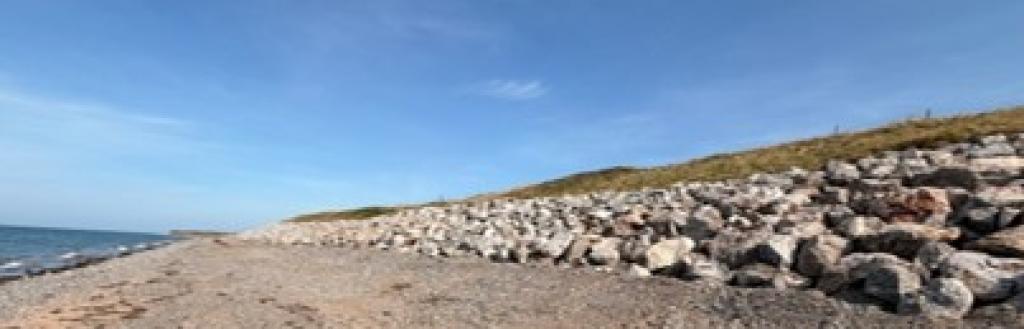
Works at South Walney to help protect the former landfill site from the effects of erosion have completed, strengthening the coastline’s resilience as we head into the winter months.
Westmorland and Furness Council carried out work on the site to help strengthen the long-term stability of the coastline while safeguarding the surrounding environment.
The works involved reshaping the edge of the landfill that faces the sea to create a gentler slope helping to reduce erosion and slippage. The new slope has been protected with several layers including a protective liner, smaller rocks, and large rocks on the outside while coir matting has been installed to promote vegetation growth.
The scheme has also been designed to support the coastal landscape as it establishes around the new defences. This includes plug planting of coastal vegetation within the rock armour alongside a coastal meadow seed mix within the coir matting.
Existing materials were reused as part of the works wherever possible. The previous rock armour revetment at the toe of the embankment was retained with stones incorporated into the new structure to reduce waste and the need for additional material. In total, around 250 metres of improved erosion revetment was constructed, designed to provide protection against one in 100-year seawater overtopping events.
The scheme was carefully designed to extend inland in order to reinforce the existing landfill containment area, rather than expanding further onto the foreshore. This approach helped to avoid disruption to natural coastal processes, including sediment movement and longshore drift along the shoreline.
Councillor John Murray, Cabinet Member for Climate, Biodiversity and Regulatory Services, said:
“The completion of these works marks an important milestone in protecting the South Walney coastline and the former landfill site from increasing pressures associated with coastal erosion and more frequent extreme weather linked to climate change.
“With the improved defences now in place as we approach the winter months, the site is better equipped to withstand challenging coastal conditions. Importantly, the scheme has also been designed with the surrounding landscape in mind, combining strengthened defences with measures to help coastal vegetation establish.”
Construction was carried out on schedule and delivered in five phases to minimise disruption to the beach, nearby fields and surrounding habitats.
Councillor Andrew Jarvis, Deputy Leader and Cabinet Member for Finance, added:
“We understand how important this stretch of coastline is to local people and for wildlife. Throughout the project, we worked to provide long-term protection while respecting the natural coastal environment.
“Delivering the scheme to programme, and completing construction on schedule, reflects the careful planning that has gone into the project. By reusing existing materials, carefully phasing the work and introducing new coastal planting, we have delivered improved resilience for years to come while keeping disruption and the impact on the surrounding environment to a minimum.”
