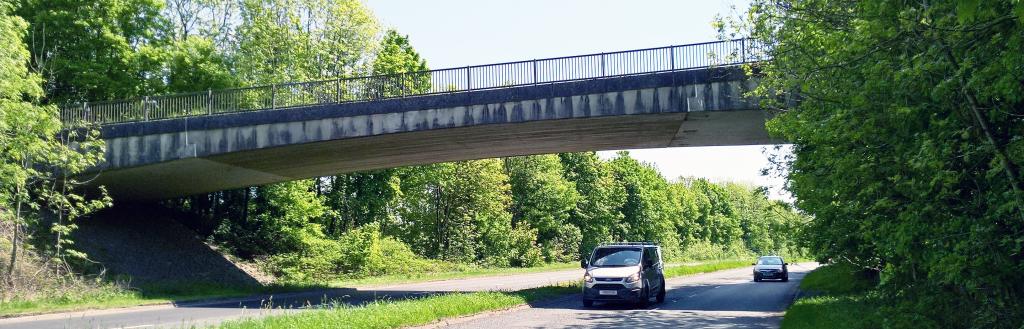
Urgent action is being taken to protect two Kendal bridges from the risk of damage or collapse after repeated breaches of weight restrictions.
The results of recent camera monitoring on Brigsteer and Underbarrow bridges, which both cross the A591, has shown multiple breaches of the 7.5 tonne weight restriction, which was put in place after the bridges were classified as weak structures.
HGVs typically weighing up to 40 tonnes have been observed making return journeys over the bridges. Over a 13-day period of monitoring, nearly 30 weight restriction breaches were identified.
Westmorland and Furness Council’s Cabinet member for Highways and ICT, Councillor Peter Thornton, said: “We know a number of these vehicles are travelling to local businesses or properties. These are not lost drivers from out of the area following a sat nav, these appear to be delivery vehicles serving the local area and breaching the weight restrictions, ignoring the signage and not using the designated alternative routes for larger vehicles.
“Unfortunately, the severity of the breaches highlighted by the monitoring, both in terms of the number and weight of the vehicles, presents an unacceptably high risk. Allowing this to continue could damage the bridge structures and, in a worst-case scenario, cause a collapse of the bridge deck onto the A591 below.
“We have therefore been left with no alternative but to introduce physical measures to prevent larger vehicles using the bridges.
“Having considered various options, we are implementing a 6’6” width restriction with immediate effect. This will initially be through temporary traffic management, with permanent remodelling as soon as possible. To ensure vehicles approach the new width restrictions at a safe speed, a 20mph speed limit will also be in place.’’
Brigsteer and Underbarrow bridges, which are reinforced concrete half joint structures erected in the 1970s, were initially closed to all vehicles in 2024 following assessments by external experts that identified structural concerns.
Following further testing, survey works and detailed structural analysis by experienced consultants, the bridges were re-opened, initially under a 3 tonne weight restriction, then increased to 7.5 tonnes in February 2025.
The council’s consultant engineers confirmed that no further refinements were possible, and the bridges must permanently remain at a 7.5 tonne limit. As the bridges are now classified as weak structures, no exceptions to the weight limit could be permitted.
Clear signage was put in place advising of the new weight restrictions and a traffic regulation order was created, meaning the weight limit is legally enforceable by police and anyone caught breaching the restrictions could be subject to prosecution or fines.
Councillor Thornton continued: “Due to the scale and regularity of the blatant weight restriction breaches, even tougher enforcement, such as use of number plate recognition cameras to catch the culprits, wouldn’t be enough to prevent the unacceptable risk.
“The A591 runs below these bridges and we simply can’t risk a potentially catastrophic incident if part of the structure fell onto the carriageway below. Cameras may catch people after they’ve breached the restriction, but by then it could be too late. It’s vital we take action to stop the breach from happening in the first place if we are to fully protect road users.
“Unfortunately, the only way we can do this is by installing physical width restriction measures. These measures should ensure that vehicles will only be able to cross the bridges if they are both less than 7.5 tonnes gross weight and less than 6’6” wide.
“We recognise that some vehicles under 7.5 tonnes gross weight, previously able to use the bridges, will now be too wide to cross. Such vehicles could include supermarket delivery vehicles, agricultural tractors and emergency ambulances, although first-responder paramedic vehicles will still be able to cross. We have already contacted the relevant emergency services so they can adjust their response plans accordingly.
“This is a regrettable consequence of the new measures. It is unfortunate that the actions of the drivers who have been breaching the weight restrictions has led to this, but it is now the only safe way to keep the bridges open, retaining connectivity for local communities while maintaining the highest safety standards."
Answers to your questions
Why has a physical width restriction been put in place on Brigsteer and Underbarrow Bridges?
To ensure that vehicles that are too heavy to safely use the bridges cannot cross. Unfortunately, an unacceptably high number of people have been ignoring the current weight limit signs, and have been crossing the bridges in vehicles that far exceed the safe capacity of the bridges. Such illegal breaches of the weight limit present an unacceptably high risk of structural collapse.
What vehicles can now cross the bridges?
Vehicles need to be both less than 7.5 tonnes gross weight and less than 6’6” (2m) in width. This will mean that some vehicles that are less than 7.5 tonnes will now be too wide to cross.
Why has 6’6” been chosen for the width restriction?
This width restriction will ensure that no vehicle greater than 7.5 tonnes can cross the bridges. It is recognised that some vehicles under 7.5 tonnes gross weight will now not be able to cross, however a wider physical restriction would not prevent the potential for unsafe breaches.
For how long will these restrictions be in place?
The restrictions will be permanent, or until such time as funding is available to replace the bridges.
The initial temporary traffic management will be replaced with permanent remodelling of the highway as soon as practicable.
Is it possible to further improve the weight limit on the bridges to allow larger vehicles to safely cross?
Our consultants have confirmed that no further improvements are possible, and the structures must permanently remain at a 7.5 tonne limit.
As the bridge is classified as a weak structure, no exceptions to the weight limit can be permitted.
Brigsteer and Underbarrow bridges highlight the challenge of maintaining our aging infrastructure and the numerous historic concrete and masonry structures across our area.
Many of these are listed and require specialist, costly heritage methods and materials for preservation and we have a number of bridges under a weight limit to ensure safety.
While we continue to monitor and maintain these structures, delivering permanent solutions for Brigsteer and Underbarrow bridges would require significant funding commitments from the Government.
Why can’t enforcement cameras be used instead?
It is questionable whether enforcement would be effective in preventing the breaches – and it is important that the breaches are stopped to ensure the bridges remain structurally safe. This can only be done with a physical restriction.
Cameras also cannot automatically visually determine vehicle weight, and with a 7.5 tonne restriction, it would be difficult from a visual inspection of a large box van, for instance, to confidently establish whether it is 7.5 tonnes or above.
More importantly, enforcement cameras would not prevent larger vehicles from breaching the weight restrictions and putting the bridges at risk of collapse: they would only serve to provide evidence for a prosecution after the breach has happened – by which time damage to the bridge could already have occurred.
What evidence do you have that vehicles heavier than the current 7.5 tonne weight limit have been crossing the bridges?
We have undertaken monitoring of the vehicles crossing the bridges since the bridges were reopened to limited traffic last year.
Although initial surveys and feedback indicated that heavy vehicles may have been crossing the bridges, recent camera surveys in the past few weeks that have been monitored by staff have ascertained clear and extensive breaches by vehicles far exceeding the safe capacity of the bridges.
Some of these vehicles were HGVs weighing up to 40 tonnes - that’s more than five times the weight restriction.
If you have evidence of large vehicles breaching weight restrictions, are you passing that evidence to police and will these drivers/companies be prosecuted?
We have made the police aware of the breaches. However, the method and quality of the camera surveys mean that the data we have collected cannot be used for enforcement purposes.
There are many ‘weak bridges’ in the area that have weight restrictions, but which have no physical barriers. Why are Brigsteer and Underbarrow different?
Most bridges that are weak are subject to an enhanced inspection regime to monitor whether any potential breaches of the weight limit are causing damage to the structure; if defects are found further action is taken to safeguard the public from collapse of the bridges.
In the case of Brigsteer and Underbarrow, due to the reinforced concrete half joint structures, the defects that would warn of damage due to overloading, that could potentially lead to structural collapse, are hidden from view and cannot therefore be monitored as easily.
As such, there would be no obvious warning signs prior to parts of the bridge structure collapsing onto the A591 below. It is therefore imperative that Westmorland and Furness Council ensure that breaches of the weight limit do not continue.
What are you doing to ensure alternative routes remain suitable for vehicles over 7.5 tonnes?
Alternative routes for vehicles over 7.5 tonnes (and now wider than 6’6’’) that are unable to use the bridges are already indicated on signage. As for all roads across Westmorland and Furness, they will continue to be maintained.
If you would like to report a problem on the diversion route please use the highways online reporting form.
How do I check the weight of my vehicle?
The maximum permitted gross and the axle weights of your vehicle can be found listed on 'plates', which must be fitted to all vehicles and certain trailers.
These will either be a manufacturer's plate or a Department of Transport plate and are usually located either in the cabin or under the bonnet of vehicles or on the chassis of trailers. The weights are given in metric units of kilograms (kg).
My business was previously served by vehicles that were less than 7.5 tonnes in weight, but which are now too wide to cross the bridges. Will I be eligible for compensation?
We recognise the impact caused by these essential safety measures, however there is no statutory provision or compensation available for impacted businesses, as set out by the Government.