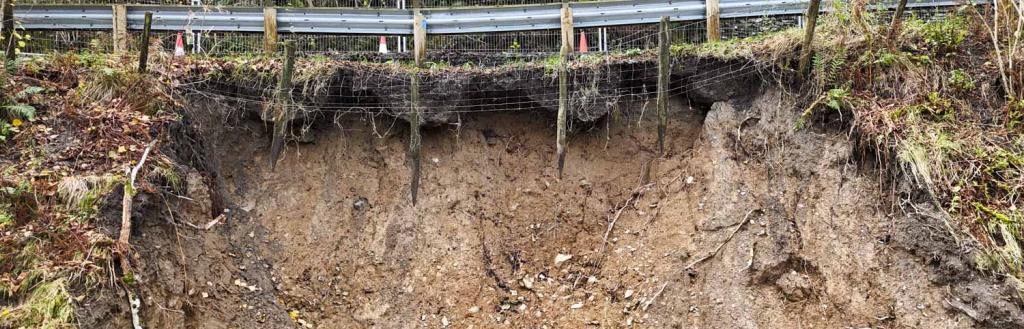
Where is the landslip exactly?
The landslip has occurred on a narrow section of the A592 at High Kingate, just north of Troutbeck and before the A592 becomes Kirkstone Pass.
What3words location: epidemics.ghosts.treaties
Does that mean Kirkstone Pass is closed?
No. You can still access Kirkstone Pass from the northern end, via Patterdale and Glenridding along the A592.
The minor local road known as The Struggle, which drops down from Kirkstone Pass to Ambleside, is also still open, although, as the name suggests, this is a very steep and narrow route and not suitable for larger vehicles.
The Struggle is also exposed to the elements and becomes increasingly difficult to access, even for small vehicles, in poor weather/winter conditions.
What has happened?
A section of the steep banking alongside the A592 at High Kingate has slipped, undermining the carriageway, following recent heavy rainfall.
A large amount of the hillside has dropped down the banking into the valley below.
There is a void under the road and the road safety barriers at the edge of the road have been left hanging in the air.
There is a considerable elevation difference on this section of slope and due to the weather there is an ongoing risk of further deterioration.
Following the landslip, the council’s highways team put in place an emergency road closure and installed barriers to prevent people trying to use the closed section, while continuing to allow farmers and local landowners access to their fields.
Measures have already been taken to try to stabilise the ground and divert water away from the landslip site to prevent further collapse.
Do you know why there was a landslip?
Technical assessments and surveys are continuing both to determine the issue and to establish the best way to repair.
Our first priority has been to make the area safe and prevent access across the section of road that has been undermined by the landslip.
How long will it take to fix?
The technical assessments and proposals from specialist consultants and contractors will help us to determine timelines, but it is safe to say the repair will take months rather than weeks.
The site is particularly complex and challenging, with narrow access and steep slopes both below and above the landslip site. It will be necessary to access the site and this means access via a steep banking below the landslip area.
Specialist technical consultants have been appointed to determine the best way to carry out the repair.
Emergency procurement processes have been used to move quickly to engage the expert consultants, so work can start as quickly as possible.
The next stage will be to carry out surveys and ground investigations to determine the best way to reach the site of the landslip and assess ground conditions, so the works can be safely carried out.
Until those technical assessment and ground investigations are complete, it is hard to determine the exact engineering solution. The onset of the winter months make the site even more challenging with ground conditions that are very wet or icy.
Realistically, we are working on the assumption that it won’t be possible to commence main works until ground conditions improve in the Spring at the earliest, although we will be in a better position to comment on the repair methodology and likely timeframes when we have the reports from the consultants when they have carried out their assessments.
Why can’t you just re-route the road around the landslip area?
We have seen it suggested that we could ‘simply’ chip away a bit of the hillside and re-route the road. Unfortunately, that isn’t a viable option.
There is a steep banking dropping down onto the carriageway at High Kingate and a steep banking below. The engineering (and cost) required for such a proposal would be huge - and anything but simple!
What are the diversion routes?
We are only allowed to sign official diversions along main routes, that can be accessed by the majority of vehicles.
So, while there may be shorter routes, via minor roads familiar to locals, we can’t sign these as an official diversion.
For that reason, the official diversion for vehicles travelling from the south/west (Troutbeck side) is via the A591 to Kendal, A6 to Penrith, A66 and A592, and from the north/east A592 and A66 (Penrith) then A6 south to Kendal and A591 to Troutbeck.
Signs advising of the closure and the designated diversion routes have been put in place along all main routes leading up to the A592. The towns and villages either side of the closure are still fully accessible via the diversions and nowhere is cut off.
In addition to the regular signs, six electronic ‘matrix’ signs have been brought into the area to support messaging about the closure and that local businesses are still accessible.
For a map showing the diversion route, right click on the link below and select 'open image in new tab'
What about roadworks on the diversion routes?
Utility companies have a legal right to undertake works on the council’s road network, but the council manages and co-ordinates works through a permit system to try to minimise disruption.
The council doesn’t have the power to ‘ban’ all works on the road network in the area around the A592 closure and urgent works – for example to repair a water or gas leak – may still need to be carried out by utility companies.
The council has contacted utility companies to advise them of the landslip issue and to ask them to consider postponing or rescheduling routine or pre-planned works on the diversion route while the A592 closure is in place, to avoid further pressure on these routes.
The council itself is also looking to reschedule any of its own planned routine highway maintenance works on these parts of the network.
Wherever possible, the council will look to ensure any urgent or essential works that have to be carried out at this time will be done under traffic light controls rather than full closures to minimise further disruption.
Is The Struggle still open – isn’t that a quicker diversion route?
Yes, The Struggle is still open with the existing 6’ 6” width restriction. This doesn’t form part of the official diversion route for the reasons outlined above, but we recognise it is a route that will be used by locals in particular.
As the name suggests, The Struggle is a very steep and at several points a very narrow route and is not suitable for larger vehicles, especially in poor weather/winter conditions.
Our gritting teams will be treating The Struggle during the winter months to maintain this link between communities either side of the closure, but we are not promoting it as an alternative route and drivers are reminded that this road will be challenging in the heart of the winter months.
During the landslip closure we would therefore urge caution trying to use this route in an unsuitable vehicle or in difficult conditions and ask that people do not use designated passing places for parking or for overnight stays, to minimise the risk of blocking the route, vehicles becoming stuck or preventing access for our gritters.
Additional matrix signs have been installed at the top and bottom of The Struggle that will carry messages about width restrictions and the unsuitability of the route for larger vehicles. The signs will also advise when gritters are treating the route, asking drivers to wait until the gritting wagon has completed its run to avoid the risk of blocking the road.
We are reviewing restrictions on this route to limit the size and weight of vehicles that can use the road during the period of the closure on the A592.
Have you put up signs informing people that the road is closed?
Signs have already been put up to warn people about the closure. We have added additional signage on all affected routes, including ‘matrix’ signs on key routes to advise drivers that the road is closed long before they get there, as well as to promote that businesses remain open and are accessible via alternative routes.
We have also added additional matrix signage and new advisory signs around places like The Struggle.
What about the impact on communities and businesses, particularly in the Ullswater Valley?
We are very aware that the closure will cause inconvenience for communities and could have some impact on businesses either side of the closure, particularly hospitality businesses.
The council is working with Cumbria Tourism to share messages that communities remain ‘open for business’ during the closure and we have already held briefings with parish councils in affected areas and will be keeping all these key stakeholders updated as things develop.
We want to try to work with our communities at this time and are committed to supporting them.
Can cyclists get through the closure?
At present the road is closed to all users, including pedestrians and cyclists, and we will incorporate that into the road signs as we review all the arrangements around the route.
We are assessing whether any public rights of way alongside and down into the valley could be suitable as an alternative route around the closure for cyclists.